
Prints
♦ ♦ ♦ ♦ ♦
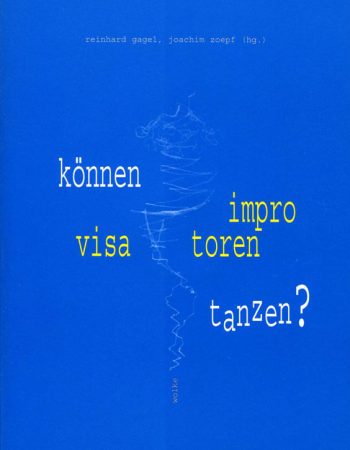
Was trennt und was verbindet die improvisierte Musik mit der komponierten Musik?
Welchen Platz hat die sie in der zeitgenössischen Kunstpraxis? Mit welchen künstlerischen Strategien improvisieren die Musikerinnen und Musiker?
Diese Leitfragen standen im Mittelpunkt des »Symposiums Improvisierte Musik«, das 2000 in Köln stattfand. Geladen waren für Workshops, Konzerte und Vorträge namhafte MusikerInnen, Komponisten und Journalisten, die sich praktisch und theoretisch mit der Improvisation auseinandersetzen.
Mit einer CD und einem Textbuch liegt hier nun die Dokumentation dieses Symposiums vor.
»Ein kleiner Band und ein Muss für Improvisationsmusiker, der wegen seiner offenen Perspektiven und der Lebhaftigkeit der unterschiedlichen stilistischen Ebenen auch für alle anderen Musikinteressierten gut und spannend zu ›leshören‹ ist. Stephan Froleyks
What separates and what connects improvised music with composed music?
What place does it have in contemporary art practice? What artistic strategies do musicians use when improvising?
These key questions were the focus of the ‘Symposium on Improvised Music’ held in Cologne in 2000. Renowned musicians, composers and journalists who deal with improvisation in both practical and theoretical terms were invited to participate in workshops, concerts and lectures.
The documentation of this symposium is now available in the form of a CD and a booklet.
„A small volume and a must for improvisational musicians, which is also enjoyable and exciting to “read” for all other music lovers due to its open perspectives and the liveliness of the different stylistic levels. Stephan Froleyks

Seit 2017 erkundet das Ensemble Art-Interplay einen Raum, der sich festen Kategorien entzieht: das produktive „Dazwischen“ von Musik, Tanz, Zeichnung und Film.
In ihren Performances treffen Trommelzeichnungen auf experimentelle Klanglandschaften, Bewegung auf visuelle Spur, Kamera auf Klang – ohne Partitur, ohne Hierarchie, ohne vorgefertigtes Muster. Was entsteht, ist ein fragiles Kraftfeld kollektiver Improvisation.
Dieses Buch analysiert erstmals umfassend die künstlerische Praxis des Ensembles. Philosophische, kognitionswissenschaftliche und musiktheoretische Beiträge untersuchen jene Momente, in denen Kontrolle und Loslassen in produktiver Spannung stehen – eine „Oszillation der Agency“, die zum Motor ästhetischer Erfahrung wird. Zugleich dokumentieren die Autor:innen konkrete Arbeitsweisen, Methoden und Werkzeuge einer radikal dialogischen Kunstform.
Art-Interplay versteht sich als demokratisches Experiment: als Modell für Kommunikation jenseits disziplinärer und hierarchischer Grenzen. Das „Dazwischen“ erscheint hier nicht als Leerstelle, sondern als dynamischer Resonanzraum, in dem neue Ausdrucksformen entstehen.
Ein Buch für Kunstschaffende, Theoretiker:innen und alle, die Improvisation nicht als Ausnahme, sondern als Erkenntnisform begreifen.
Since 2017 Art-Interplay ensemble has been exploring a space that defies fixed categories: the productive ‘in-between’ of music, dance, drawing and film.
In their performances, drum drawings meet experimental soundscapes, movement meets visual traces, camera meets sound – without a score, without hierarchy, without a pre-determined pattern. What emerges is a fragile force field of collective improvisation.
This book is the first comprehensive analysis of the ensemble’s artistic practice. Philosophical, cognitive science and music theory contributions examine those moments in which control and letting go exist in productive tension – an ‘oscillation of agency’ that becomes the motor of aesthetic experience. At the same time, the authors document the concrete working methods, techniques and tools of a radically dialogical art form.
Art-Interplay sees itself as a democratic experiment: as a model for communication beyond disciplinary and hierarchical boundaries. The ‘in-between’ does not appear here as a void, but as a dynamic resonance space in which new forms of expression emerge.
A book for artists, theorists and anyone who understands improvisation not as an exception, but as a form of knowledge.